
A collaborative data notebook for analysts and scientists that integrates Python, SQL, and AI assistance.
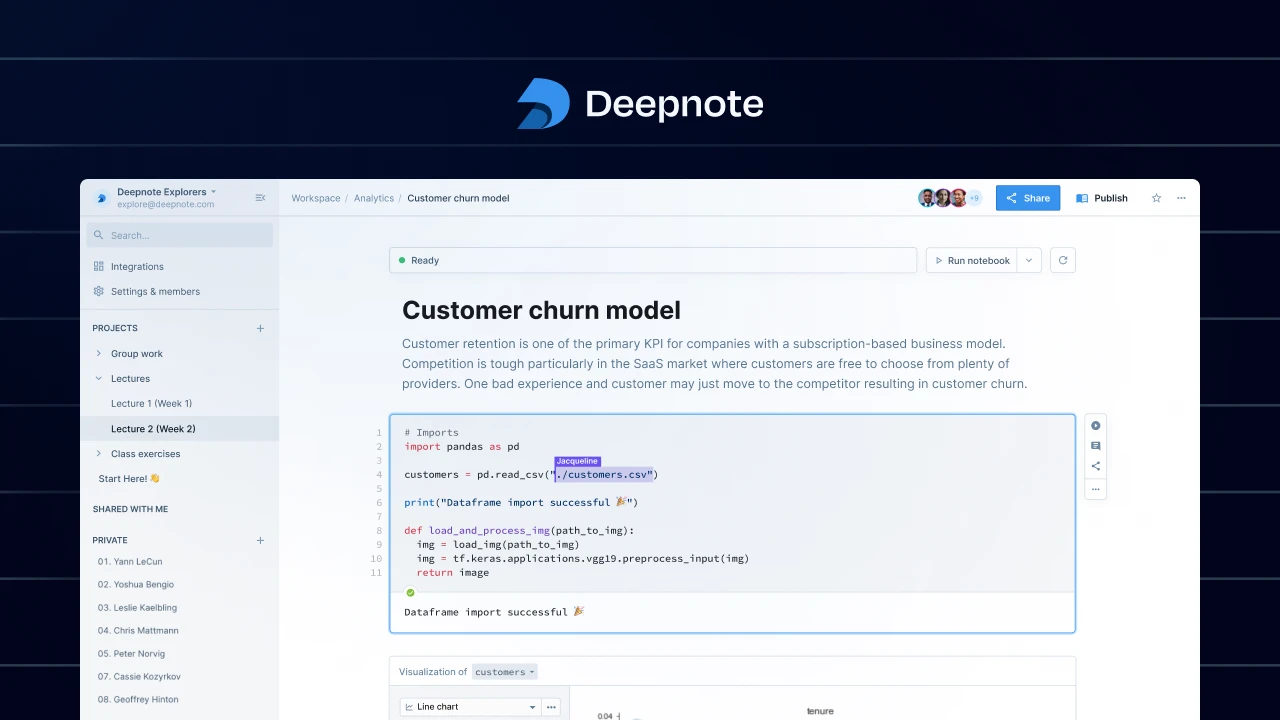
Deepnote is an open-source web app and server that provides a collaborative notebook environment for data analysts and scientists. It functions as a replacement for Jupyter, allowing users to combine Python, SQL, and data visualization within a single workflow. The software is deployed as a web application or used locally via a CLI and editor extensions, making it suitable for both individual research and team based data science projects.
Users can work locally using the Deepnote Toolkit and then migrate projects to a cloud environment for increased compute and team collaboration. The system supports various notebook formats and integrates with AI-native code editors to facilitate data exploration, exploratory data analysis, and machine learning tasks. It is designed to bridge the gap between local development and scalable cloud infrastructure.
Key features
- YAML based .deepnote file format for human readable version control
- Block based architecture supporting SQL, inputs, and charts
- Reactive execution that automatically re-runs dependent blocks
- Bidirectional conversion between .ipynb, .qmd, and .py formats
- Native support for VS Code, Cursor, and Windsurf editors
- Integration of input blocks including sliders, checkboxes, and date ranges
- Separation of outputs from source code via snapshot files
- Compatibility with the Jupyter kernel for existing notebook support
The software is built on the Jupyter kernel to maintain compatibility with existing data science ecosystems. It utilizes a specific block system defined through the @deepnote/blocks package, which enables the creation of interactive elements like buttons and big number visualizations. The @deepnote/convert library allows for the import of notebooks from other platforms while preserving metadata. This architecture ensures that users can move between different notebook environments without losing project structure or data provenance.
For those in academia, the platform provides specific support for students and educators to use the tool for research and teaching. The use of a contentHash system provides code provenance, verifying exactly which version of the code produced a specific output, which is critical for reproducible research.
Deepnote is an AI-native extension of the Jupyter ecosystem, focusing on cleaner version control and collaborative data analysis.
Similar Open Source Software


Join our newsletter to get shiny new open source software delivered to your inbox. Unsubscribe anytime.