
Monitors AI agents in production by clustering failures into issues and generating evaluations from real traces.
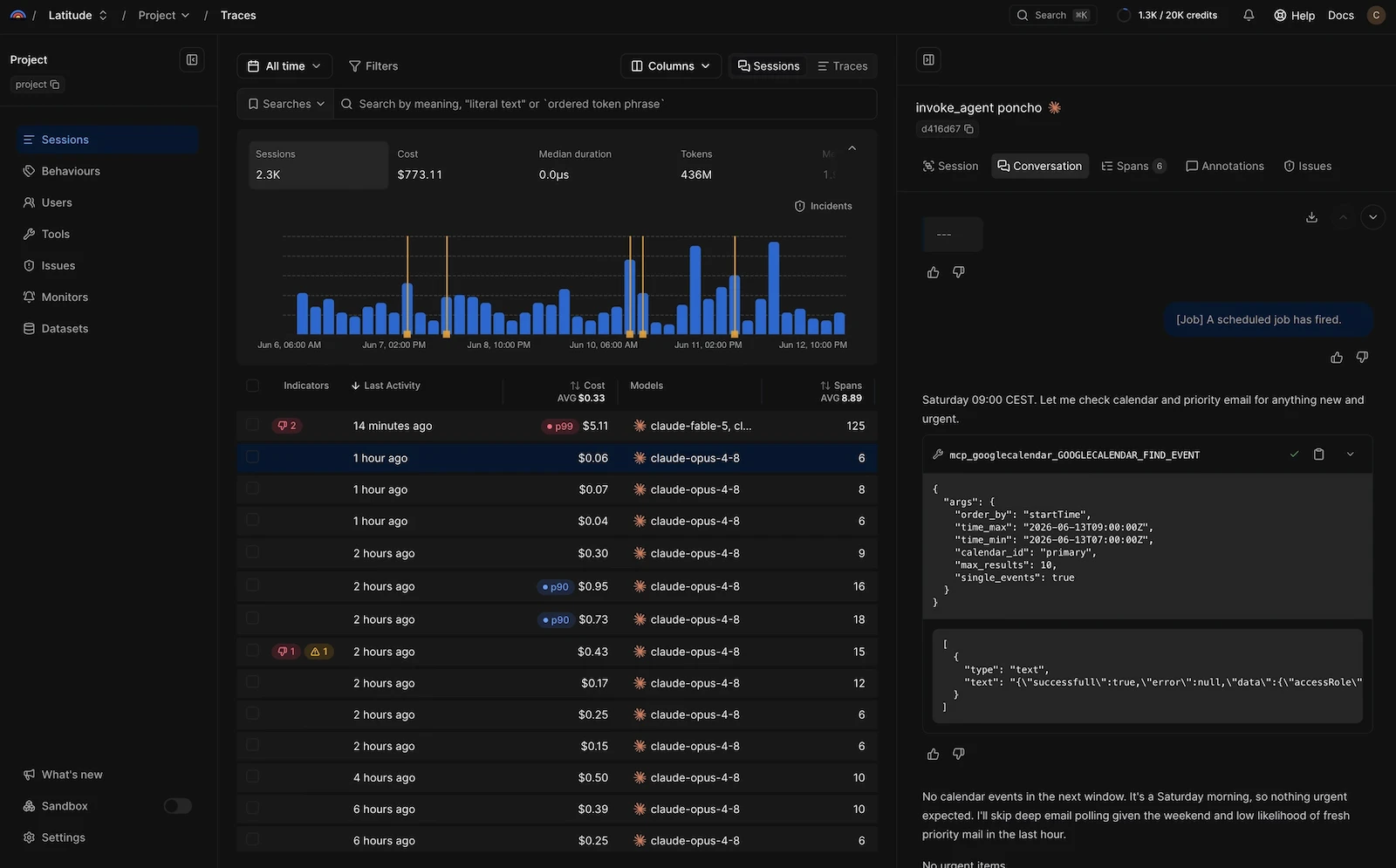
Latitude is an open-source web application that provides observability for AI agents and large language models. It monitors agent performance in production by tracing execution paths and clustering failures into trackable issues. The software is deployed as a server and accessed via a web application, with telemetry integrated into applications through dedicated SDKs or OpenTelemetry standards.
Users integrate Latitude into their codebase using TypeScript, Python, or any OpenTelemetry-compatible runtime. It supports various deployment methods to suit different infrastructure needs, including a single-host Docker Compose setup for simple installations, a Kubernetes cluster via Helm charts for high-availability environments, or one-click deployment on Railway for managed infrastructure. The platform focuses on identifying regressions and failures in AI workflows before they impact end users.
Key features
- Automatic clustering of failed traces into tracked issues with status and trends
- Generation of evaluations based on human judgments to track alignment drift
- Agent-native tracing for multi-turn sessions and tool calls
- Semantic search across 100% of traces using meaning or similarity
- Alerts for new or escalating issues via Slack, email, or webhooks
- MCP server for interacting with the platform via coding agents
- Support for OpenAI, Anthropic, Bedrock, Vercel AI SDK, and LangChain
The architecture is provider-agnostic and utilizes a telemetry system to capture request, conversation, and agent boundaries. By using the capture function, developers can attach user IDs, session IDs, and custom metadata to specific traces for better context. The system is designed for developers, data scientists, and AI engineers who need to debug complex agentic workflows and maintain quality standards through human-aligned evaluations. It also includes a dedicated package for Claude Code to capture full session transcripts as traces.
Latitude is a monitoring and debugging layer specifically tailored for the non-deterministic nature of AI agents.
Similar Open Source Software




Join our newsletter to get shiny new open source software delivered to your inbox. Unsubscribe anytime.