A flow-based development tool for visually programming event-driven applications and integrating hardware devices and APIs.
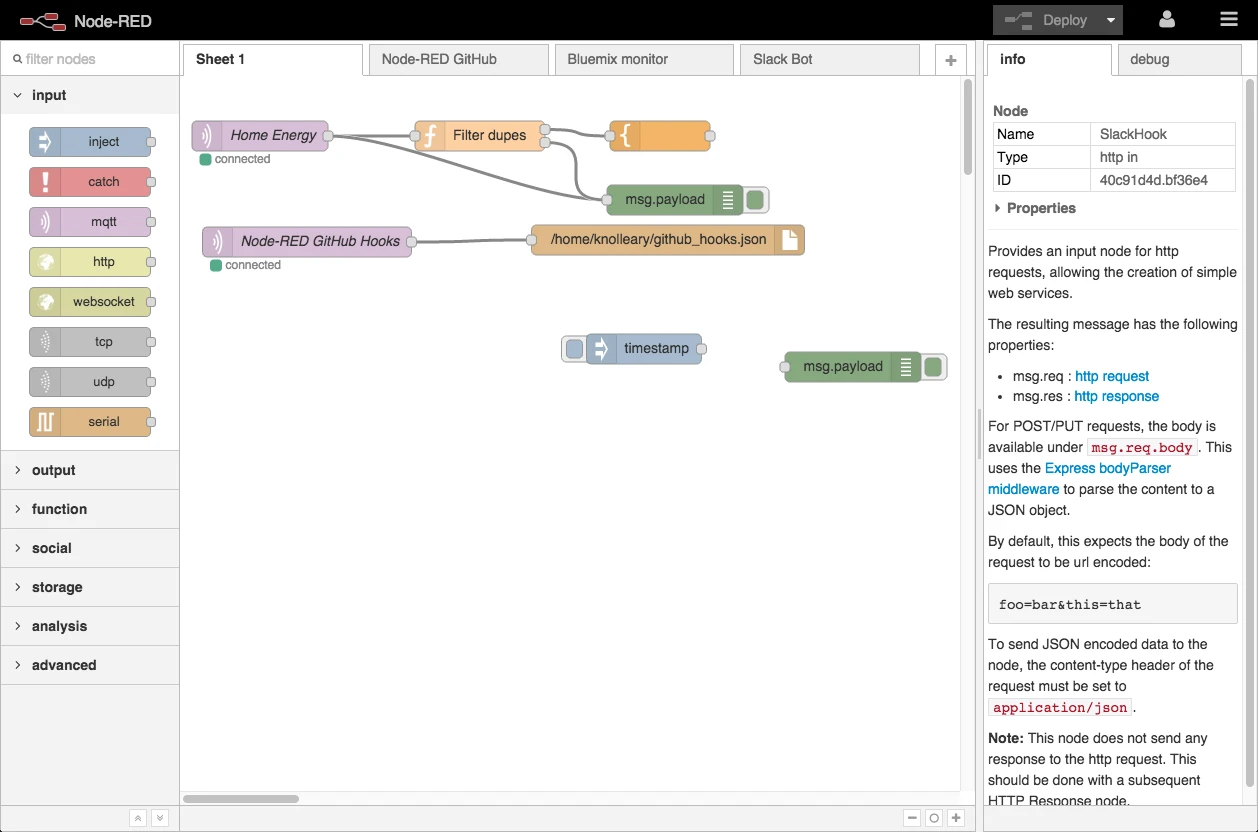
Node-RED is an open-source server application designed for visually programming event-driven applications. It employs a flow-based programming model that enables users to construct complex logic by dragging and dropping nodes onto a canvas and connecting them to define the data path. The software focuses on the integration of hardware devices, external APIs, and various online services to automate tasks and process data in real time.
Deployment is handled via npm, which allows the server to be hosted on a wide range of environments, including local workstations, cloud infrastructure, and single board computers. Users interact with the system through a browser-based editor, where they can design, test, and deploy workflows without needing to restart the server. This approach allows for rapid prototyping and iterative development of automation scripts and data pipelines.
Key features
- Visual flow-based programming interface
- Low-code development environment
- Support for event-driven application logic
- Integration capabilities for hardware devices
- API connectivity for online services
- Extensible node system for custom functionality
- Browser-based editor for workflow design
The software is built on Node.js and is maintained as a project of the OpenJS Foundation. It is intended for developers, engineers, and hobbyists who need to connect disparate software and hardware components without writing extensive amounts of manual code. The architecture allows users to create custom nodes using JavaScript, which expands the base functionality to support specific industrial protocols or proprietary internal APIs. By representing logic as a visual graph, the system makes it easier to document and debug the flow of information between different system components.
Node-RED serves as a tool for Internet of Things development and general workflow automation.
Similar Open Source Software
NocoDB
Turns existing databases into no-code platforms by providing a spreadsheet interface for data management and API generation.

Pake
Convert any webpage into a lightweight desktop application using a single command for multiple operating systems.



Join our newsletter to get shiny new open source software delivered to your inbox. Unsubscribe anytime.