
Generate RSS feeds from various websites and social media platforms that do not provide them natively.
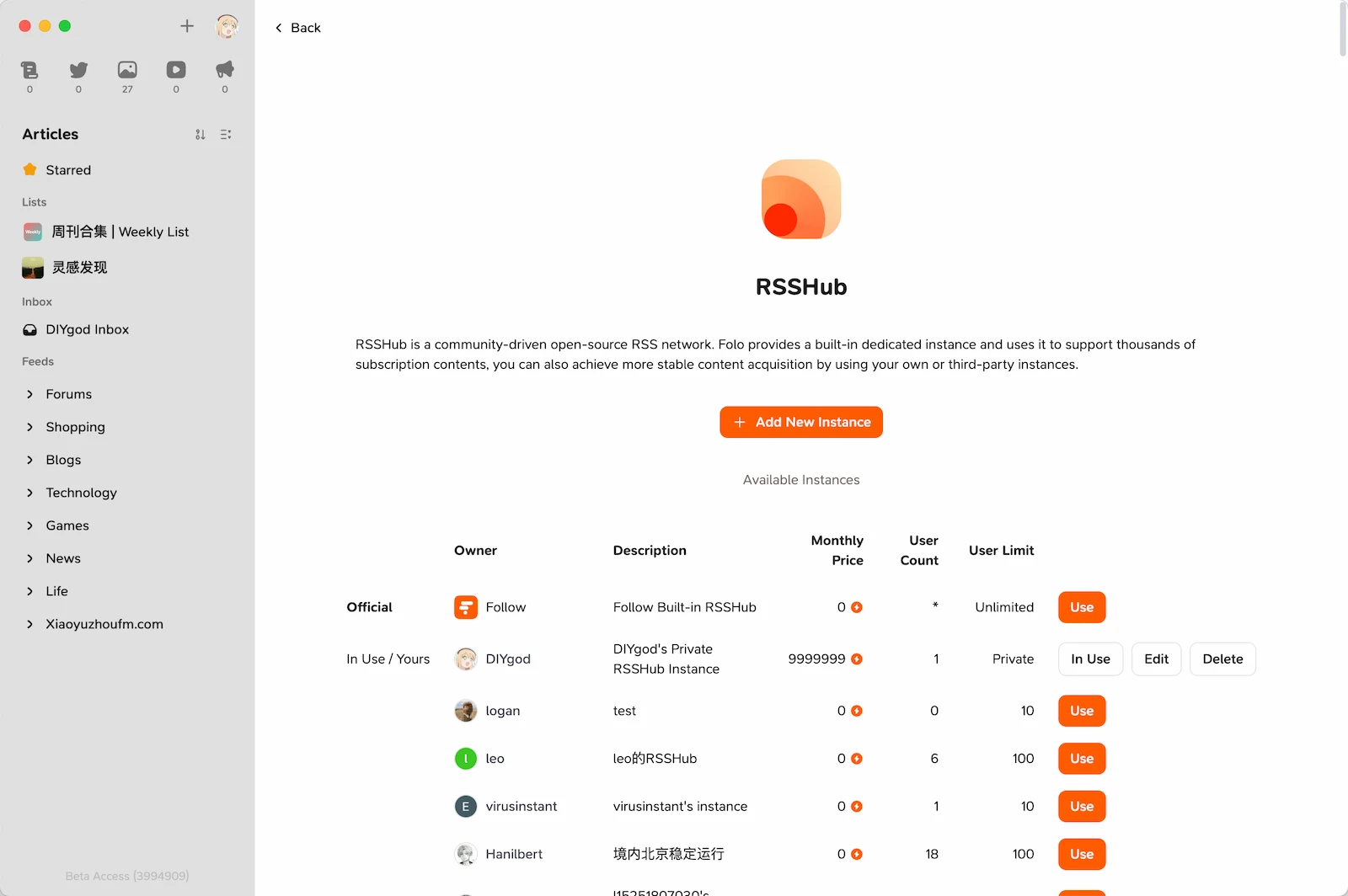
RSSHub is an open-source framework that generates RSS feeds from websites and social media platforms that do not provide them natively. It acts as a bridge between non-RSS sources and feed readers by creating standardized feeds from various web content. The software is typically deployed as a self-hosted server instance, though a large network of over 5,000 public instances also exists to provide shared access to these feeds.
Users utilize the system to aggregate content from a wide array of global sources into a single feed reader. It supports a vast range of platforms including YouTube, Twitter, Instagram, TikTok, and Spotify, as well as regional services like Bilibili, Weibo, and Zhihu. The framework allows for the creation of custom routes to target specific data from these platforms, enabling a unified stream of information from disparate web services.
Key features
- Generates RSS feeds for platforms lacking native RSS support
- Supports thousands of predefined routes for global websites
- Compatible with various feed readers and aggregators
- Deployable as a self-hosted instance for private use
- Community-driven updates for new routes and bug fixes
- Integration with RSSHub Radar for browser-based feed discovery
- Support for mobile discovery via RSSBud and RSSAid
- Extensible architecture for adding new content sources
The system is designed for users who prefer a centralized reading workflow and want to avoid visiting multiple social media sites or apps to check for updates. It functions as a backend service that scrapes or API-integrates with target sites to produce XML feeds. The ecosystem includes companion tools like RSSHub Radar, a browser extension that identifies available feeds on the current webpage, and DocSearch for integration with Raycast. It also pairs with AI-driven readers like Folo to enhance feed discovery and reading workflows.
RSSHub serves as a content aggregation layer for individuals and developers who require standardized data feeds from the modern web. It transforms the fragmented nature of social media updates into a structured format suitable for any standard RSS reader.
Similar Open Source Software



Join our newsletter to get shiny new open source software delivered to your inbox. Unsubscribe anytime.