
Monitors websites, APIs, and services with real-time alerts, status pages, and support for numerous notification channels.
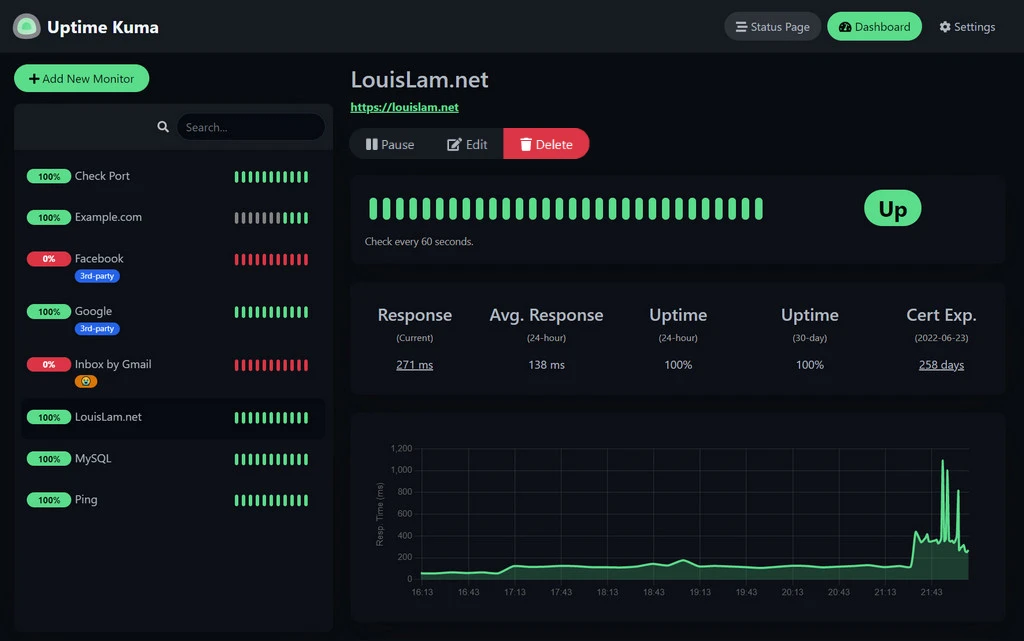
Uptime Kuma is an open-source, self-hosted web application that monitors the availability of websites, APIs, and other network services. The software is typically deployed as a Docker container or installed on Linux and Windows systems using Node.js and PM2 for background process management.
Users can track various service types and receive alerts when a monitored target goes offline. The application includes a built-in status page to communicate uptime statistics to external users. It is designed for administrators and developers who require a private monitoring solution to track their infrastructure without relying on third-party cloud services or external SaaS providers.
Key features
- Monitoring for HTTP(s), TCP, DNS records, and Ping
- Support for HTTP(s) keyword and JSON query checks
- Integration with over 90 notification services including Discord, Slack, and Telegram
- Monitoring intervals as short as 20 seconds
- Creation of multiple status pages mapped to specific domains
- Tracking of SSL certificate information
- Visual ping charts for performance analysis
- Support for 2FA and proxy configurations
- Monitoring for Websockets, Push, Steam Game Servers, and Docker Containers
The application is built as a single-page app using Vue 3, Vite.js, and Bootstrap 5. It utilizes WebSockets and Socket.io for real-time updates instead of a traditional REST API. Deployment via Docker Compose is the recommended method, though it can be run manually on major Linux distributions such as Debian, Ubuntu, Fedora, and ArchLinux, as well as Windows 10 and Windows Server 2012 R2. The architecture avoids the use of NFS file systems, requiring mapping to local directories or volumes for data persistence.
Uptime Kuma serves as a lightweight infrastructure monitoring tool for individuals and teams managing their own servers and network services.
Similar Open Source Software

changedetection.io
Monitor websites for content updates and receive notifications via Discord, Email, Slack, Telegram, or webhooks.

Gatus
Monitor service health using HTTP, ICMP, TCP, and DNS queries with automated alerting and status pages.

Join our newsletter to get shiny new open source software delivered to your inbox. Unsubscribe anytime.